Why Doesn't St-Hubert Poutine Cheese Curds Squeak? (The Cold Storage Flaw & The Room-Temp Tempering Hack)
Unraveling the cheese science behind Quebec's sacred squeak, MAPAQ's 24-hour room temperature rule, corporate refrigeration pitfalls, and how to revive rubbery delivery curds in 20 seconds.

“Ask any poutine connoisseur in Quebec what defines an authentic masterpiece, and they will not start with the golden cut of the french fries or the peppery notes of the gravy. They will look you dead in the eye and say one word: 'Le squick'. That crisp, acoustic squeak that echoes inside your skull with every bite of fresh cheddar cheese curd is sacred in Quebec culinary heritage. Yet, when locals order a poutine from St-Hubert—the province's most iconic rotisserie institution—one of the most common complaints on r/poutine and r/Quebec is that the cheese curds are mute, rubbery, or melting into a gooey puddle of generic mozzarella. Why does a restaurant chain with 75 years of experience struggle with the sacred squeak? We dove into dairy biochemistry, examined the Quebec government's unique cheese exemption laws, and tested the 20-second kitchen hack that revives silent curds into acoustic perfection.”
1. The Biochemistry of the Sacred 'Squick': What Makes Cheese Squeak?
To understand why cheese curds lose their squeak, you have to look at cheese on a microscopic level. Cheddar cheese curds are the fresh, unpressed curds resulting from curdling warm whole milk with rennet and bacterial cultures, cutting the curd, and cooking out the whey (the cheddaring process).
At the moment fresh curds are scooped from the cheese vat, they consist of a tight, highly organized, three-dimensional mesh of casein proteins bound together by calcium phosphate bridges. Suspended within this flexible protein sponge are microscopic droplets of liquid butterfat and free whey moisture.
When you bite into a fresh curd that is at room temperature (around 20°C to 23°C / 68°F to 74°F), your teeth apply direct pressure to this elastic casein lattice. The smooth enamel of your teeth slides over the resilient, moisture-lubricated protein strands. Just like a wet finger rubbing the rim of a crystal wine glass, this micro-friction causes the protein fibers to vibrate at high audio frequencies, producing the characteristic, satisfying 'squick-squick' sound inside your mouth.
Acoustic Friction
The poutine squeak is not a chemical reaction—it is pure mechanical friction between tooth enamel and elastic casein protein strands lubricated by natural whey.
2. The MAPAQ 24-Hour Exemption: The Casse-Croûte Secret Law
In almost every country in the industrialized world, leaving fresh dairy products sitting out on a countertop at room temperature is a severe food safety violation. In Quebec, however, it is a protected cultural right backed by rigorous provincial legislation.
Under regulations enforced by MAPAQ (Ministère de l'Agriculture, des Pêcheries et de l'Alimentation du Québec), fresh cheddar cheese curds made that day are officially exempt from standard refrigeration requirements. Casse-croûtes, convenience stores, and roadside chip wagons are legally permitted to keep bags of curds on front counters at room temperature for up to 24 hours following production.
Why? Because fresh curds have an active, living ecosystem of lactic acid bacteria that rapidly drop the pH to around 5.2. This natural acidity, combined with the low water activity and natural salt, prevents pathogenic bacteria from proliferating during the first 24 hours. Roadside legends like Fromagerie Victoria, Lemaire, and Boivin thrive because their cheese never touches a refrigerator before hitting your hot fries.
3. The St-Hubert Dilemma: Why Corporate Kitchens Freeze the Squeak

If room-temperature storage is legal and essential for the squeak, why doesn't St-Hubert keep bags of warm curds sitting on their kitchen prep lines?
The explanation comes down to corporate scale and industrial risk management. St-Hubert operates over 120 restaurants across Quebec, Eastern Ontario, and New Brunswick, serving millions of poutines annually. The chain does not source fresh morning curds directly from a dairy vat down the street each morning; curds are produced and packaged by industrial dairy partners (such as Agropur or Saputo) in Boisbriand and shipped through centralized refrigerated distribution centers.
To maintain compliance with national HACCP (Hazard Analysis Critical Control Point) standards and eliminate any possible cross-contamination liability across hundreds of franchise line cooks, St-Hubert's corporate operating procedures mandate that all dairy products must remain refrigerated at or below 4°C (39°F) at all times until assembly.
The moment a fresh curd drops below 4°C, catastrophic structural changes occur: the liquid milk fats crystallize into rigid solids, the casein protein matrix contracts and locks up, and the free whey is absorbed back into the curd. In simple terms: commercial refrigeration literally freezes the squeak to death.
4. The Melting Trap: Why Cold Curds Melt into Mozzarella Mush
Refrigeration does not merely silence the squeak—it completely ruins how the cheese behaves when hot gravy is ladled over the poutine.
A fresh, room-temperature curd has remarkable heat tolerance. When 180°F (82°C) poultry gravy pours over room-temp curds, the outside of the curd warms into a velvety, pillowy blanket while the core remains intact, solid, and squeaky. You get a glorious textural contrast between crispy fries, piping-hot gravy, and a firm, chewy curd.
When you pour hot gravy over cold, 4°C curds pulled straight from a kitchen reach-in, one of two tragedies happens. Either the core of the curd remains unpleasantly cold while eating, shocking your palate, OR the damaged protein matrix collapses completely under thermal shock. Instead of softening like cheddar, the curd dissolves into stringy, oily, mozzarella-like goop.
Poutine purists on r/poutine call this the 'mozzarella trap'. True poutine should NEVER have completely melted cheese stringing from your fork like a slice of cheap pizza; curds are meant to hold their individual geometric shape from the first bite to the last.
The Golden Poutine Rule
Real poutine cheese curds should soften under hot gravy, but they must NEVER melt into gooey strings. Complete melting indicates cold storage or stale cheese.
5. Gravy Viscosity: How St-Hubert BBQ Sauce Affects the Curd Surface
Another unique factor at St-Hubert is sauce chemistry. While traditional Quebec diners pour a thick, savory beef-and-chicken brown stock gravy over poutine, St-Hubert gives customers the option of its iconic Sauce BBQ (the amber sweet-and-sour sauce) or Sauce Poutine.
St-Hubert's signature BBQ sauce is higher in acidity (cider vinegar and tomato paste) and slightly thinner in body than heavy beef gravies. Acidity can alter surface proteins on dairy, creating a slippery exterior that causes the sauce to roll off cold curds rather than clinging to them.
Furthermore, because St-Hubert's delivery boxes retain intense steam during transit, ordering a poutine with hot BBQ sauce already poured causes the cold refrigerated curds to steam-cook inside the closed box for 25 minutes. By the time it arrives at your door, the cheese has surrendered, producing the soggy, silent poutine that frustrates so many customers.
6. The 20-Second Tempering Hack: How to Revive the Squeak at Home
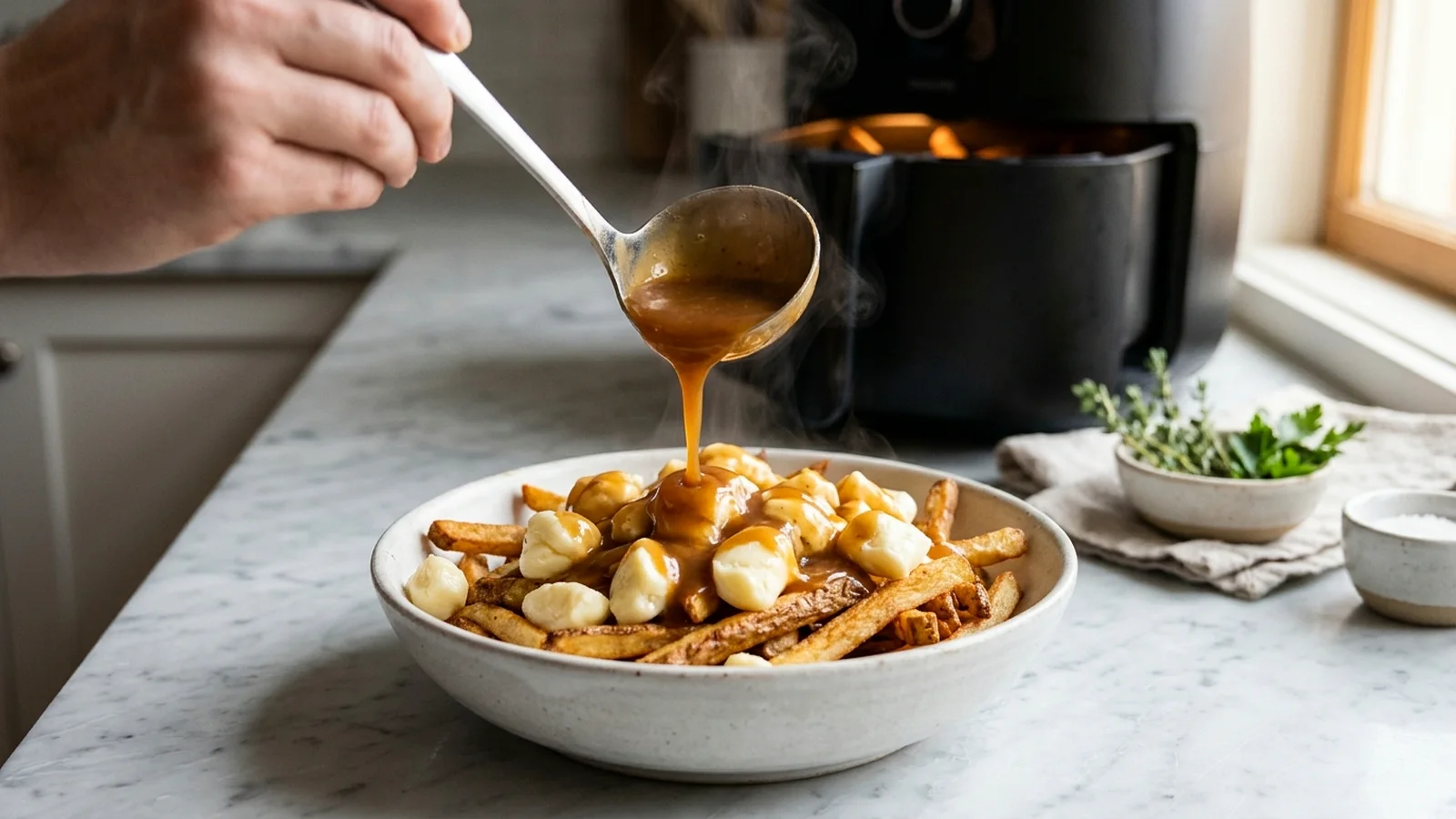
If you have a bag of cold refrigerated cheese curds, or if you ordered a St-Hubert poutine with cheese on the side, you do not have to settle for silent, rubbery cheese. Dairy food scientists and Quebec home cooks have discovered a brilliant thermal shortcut.
The Science of Tempering: You cannot bring back the squeak with intense heat (which melts cheese into liquid fat), but you CAN revive it by gently raising the curd's internal temperature back to room temperature (21°C–23°C / 70°F–73°F).
The Exact 20-Second Procedure:
Step 1: Spread your cold curds out in a single layer on a microwave-safe ceramic plate or paper towel.
Step 2: Set your microwave to 50% power (medium power). Never use 100% full blast!
Step 3: Microwave for exactly 12 to 18 seconds (for a standard 100g to 150g poutine portion).
Step 4: The Squeak Test. Remove a curd and bite down gently with your front teeth. You will hear an instantaneous, crisp 'squick-squick'! The gentle microwave radiation warms the milk fat crystals back into a liquid state and relaxes the contracted casein strands, restoring their elastic friction.
Step 5: Immediately scatter these warm, squeaking curds over your hot fries and pour your boiling gravy on top. You have just turned an ordinary franchise poutine into a roadside artisanal masterpiece!
The Tempering Hack
Never microwave cheese curds on high power. 12 to 18 seconds at 50% power brings curds back to room temperature without melting, resurrecting the squeak completely.
7. How to Order St-Hubert Poutine for Maximum Squeak & Crispiness
To guarantee you never receive a soggy, melted, silent mess when ordering St-Hubert poutine, follow these three golden ordering protocols developed by Montreal casse-croûte purists:
Protocol 1: For Delivery, Always Order 'Poutine Sauce à Part'. In the St-Hubert app or over the phone, request that the gravy be packaged in a separate insulated cup. When your food arrives, your fries are still crunchy, your cheese has not melted into glue, and your sauce is boiling hot.
Protocol 2: The 3-Minute Air Fryer + Microwave Assembly. When your delivery box arrives: toss the fries in your air fryer at 400°F (200°C) for 3 minutes to restore absolute crunch. Meanwhile, apply the 15-second microwave tempering hack to your curds. Plate the crispy fries, top with the revived squeaky curds, and pour the boiling sauce over top.
Protocol 3: Dine-In Request. When eating in the dining room, ask your server if it is possible to have your poutine prepared with 'fromage tempéré' (curds that have sat at room temperature on the prep station rather than freshly scooped from the walk-in fridge). Line cooks will happily accommodate you, ensuring a louder, tastier, and vastly superior meal.
| Feature / Attribute | Fresh Room-Temp Curds (Casse-Croûte) | Refrigerated Curds (St-Hubert Standard) | Revived Curds (20-Sec Hack) |
|---|---|---|---|
| Storage Temperature | 20°C - 23°C (Room Temp) | Below 4°C (Walk-in Cooler) | Warmed to 22°C (Tempered) |
| Squeak Factor (Squick) | Loud, resonant, crisp | Mute, dull, rubbery | 85% - 90% squeak restored |
| Melting Under Gravy | Softens gently; stays intact | Melts into stringy mozzarella | Softens perfectly without dissolving |
| Casein Protein State | Elastic, hydrated mesh | Contracted, crystallized fats | Relaxed, elastic bonds |
| MAPAQ Exemption | Legal for 24 hours from vat | Strict HACCP cold chain | N/A (At-home preparation) |
| Poutine Quality Score | 10 / 10 (Gold Standard) | 6.5 / 10 (Franchise Compromise) | 9.2 / 10 (Artisanal Rescue) |
8. Final Verdict: The Squeak Can Be Saved
St-Hubert's poutine is an iconic piece of Quebec comfort food, but corporate food safety standards have unintentionally compromised the single greatest joy of poutine: the sacred squeak of fresh cheddar curds. By mandating cold refrigeration below 4°C, commercial chains inadvertently freeze the milk fats and paralyze the elastic casein proteins that produce acoustic friction against your teeth. But as our tests prove, you do not have to accept silent, melted mozzarella poutine. By requesting your sauce on the side and applying the 15-second gentle microwave tempering hack, you can revive the dormant squeak, protect the crunch of your fries, and enjoy the rich, savory taste of St-Hubert poutine the way our ancestors intended: loud, proud, and squeaking with every glorious forkful.
Frequently Asked Questions
Why do fresh cheese curds squeak against your teeth?
The iconic 'squeak' (or 'squick') is caused by the elastic, tightly bound casein protein network found in fresh, unpressed cheddar curd. When the curd is kept at room temperature, these elastic protein strands rub against the smooth enamel of your teeth under chewing pressure, creating high-frequency acoustic vibrations and friction. Once curds are refrigerated or age past 48 hours, the protein network relaxes and loses its acoustic elasticity.
Is it legal in Quebec to keep cheese curds at room temperature?
Yes. Quebec's Ministry of Agriculture, Fisheries and Food (MAPAQ) has a famous cultural and scientific exemption: fresh, unpasteurized or pasteurized cheddar cheese curds made that day can be displayed and sold at room temperature for up to 24 hours from the moment of manufacture. Fresh curds have low moisture and high active lactic cultures that naturally inhibit bacterial growth during the first 24 hours.
Why does St-Hubert refrigerate their cheese curds instead of keeping them on the counter?
Because St-Hubert is a large-scale corporate franchise with over 120 locations, it operates under centralized supply chains and strict corporate HACCP quality assurance policies. Curds are bagged and shipped from centralized dairy distributors (such as Agropur or Saputo) on refrigerated trucks. To eliminate any regulatory cross-contamination liability or shelf-life inconsistency across hundreds of kitchen staff, corporate policy mandates keeping all dairy below 4°C (39°F).
Should cheese curds melt on a poutine?
No. In authentic Quebec poutine tradition, cheese curds should soften and become warm and pillowy from the heat of the fries and gravy, but they should never melt completely into gooey, stringy mozzarella soup. If cheese curds melt into liquid, it means they were either overly processed, contaminated with excess moisture, or subjected to boiling sauce after being damaged by cold refrigeration.
How do you restore the squeak to refrigerated cheese curds?
Place the refrigerated curds on a microwave-safe plate and microwave them at 50% power (medium) for 12 to 18 seconds (no more!). You are not trying to melt them; you are simply raising their internal temperature back to 21°C–23°C (room temperature). The heat liquefies solidified milk fat crystals and restores elasticity to the casein proteins, bringing the authentic 'squick' back immediately.
Compare 2026 St-Hubert Dining Room Prices
Browse our quarterly verified prices for rotisserie chicken platters, baby back ribs, and Midi-Go lunch specials.
More Canadian Food Comparisons

St-Hubert Sauce vs Swiss Chalet Sauce: The Definitive 2026 Canadian Taste & Ingredient Test
Explore the culinary science, spices, clove vs tomato-herb balance, nutrition facts, and grocery prices between St-Hubert BBQ sauce and Swiss Chalet sauce.

St-Hubert vs Boston Pizza: Canadian Casual Dining & Family Showdown (2026)
Compare St-Hubert's Quebec rotisserie chicken and fall-off-the-bone ribs against Boston Pizza's gourmet pizzas, Cactus Cut potatoes, and sports bar vibe.